Top CMS trends for non-profits: What does the data say?
We analysed the CMS history of UK non-profits to cut through the hype and find out what direction CMS's are really going into the future.
Background
In 2024 we did some detailed analysis of the UK market and this included looking at non-profits.
- We used the uk register of non-profits as the base list
- We included only organisations with currently active websites and only one website per organisation
- We restricted the list to those with a last year income of above 800k GBP.
- We then looking at their entire website history, what CMS was used and when it changed.
- We then grouped the CMS used into 4 categories. Open source, licenced, Headless, and Site Builder. There is a 5th category where we weren't able to determine a CMS was used (Unknown).
While UK non-profits aren't representitve of all websites globally it does have some unique qualities that mean we can use generalise
- The websites are what is officially registered with the UK government so there will be very little in the way of spam websites
- It is perhaps a more conservative market so should show clear trends over time
- The sites are more content focused and less likely to use eCommerce type solutions
The CMS trends in 2024
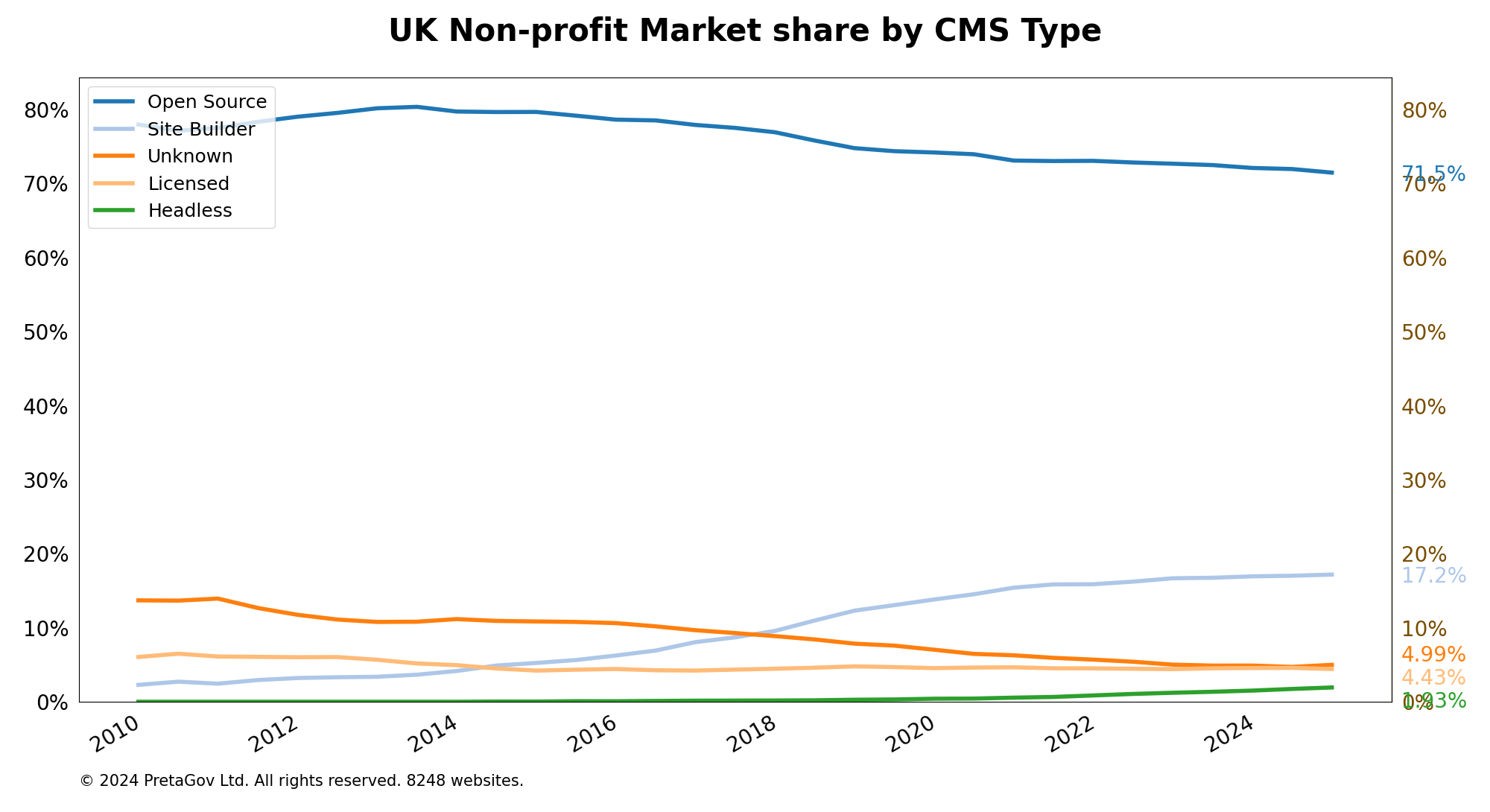
As you can see while open source is clearly still the domonant style of CMS its dominance is being reduced by site builders and headless CMS.
We defined CMS as follows
- Open Source CMS. Any CMS that self idenified as Open Source however we excluded some open core CMS where the CMS is too limited to be used without the licensed plugins. This did end up including some CMS's that were previously licensed but are now open source. We haven't yet incorporated switch over dates for those CMS.
- Headless CMS: Any CMS that self identified as headless or api-driven minus some that had histories before they started to advertise themselves as headless and there didn't seem to be much evidence that those using it were using it in a headless way. Any site using frameworks such as Gatsby, Nuxt.js, Next.js, Astro we included as well as any site hosted on PaaS designed for static site generators like Netlify or Vercel.
- Site builders is a CMS designed to let non technical users pick a preexisting theme with various options or provide a editing experience that let you customise the look and feel of the entire site with the need for customising code. Generally any CMS that offered a recurring priced solution and was SaaS and wasn't open source. There is an additional category of offline site builders where the site is statically generated using purchased software locally and then uploaded. These go back to Dreamweaver and include some modern CMS although this is a small and shrinking category. We inclided these offline site builders into the Site builder category because they generally are offering a non technical site custimisation experience without the use of developers.
- Licensed. This is CMSs that required a fixed or recurring payment to use but wasn't SaaS.
- Unknown. In some cases it could be determined that a framework was used by not the CMS. This could mean the CMS was custom, as yet unidentified, a hand crafted landing page, a known that CMS where the fingerprint we used to identify it is not perfect. We've used techniques to reduce obvious errors like removing parking pages, error pages and other blips in the data. When more work is put into identifying recent unknowns, more often that not they tend to be niche site builders or custom CMS offered by agencies.
Headless CMS trends in 2024
While headless is a small segment (just under 2%) it is the fastest rising in market share and that rise has accelerated in the last 3 years.
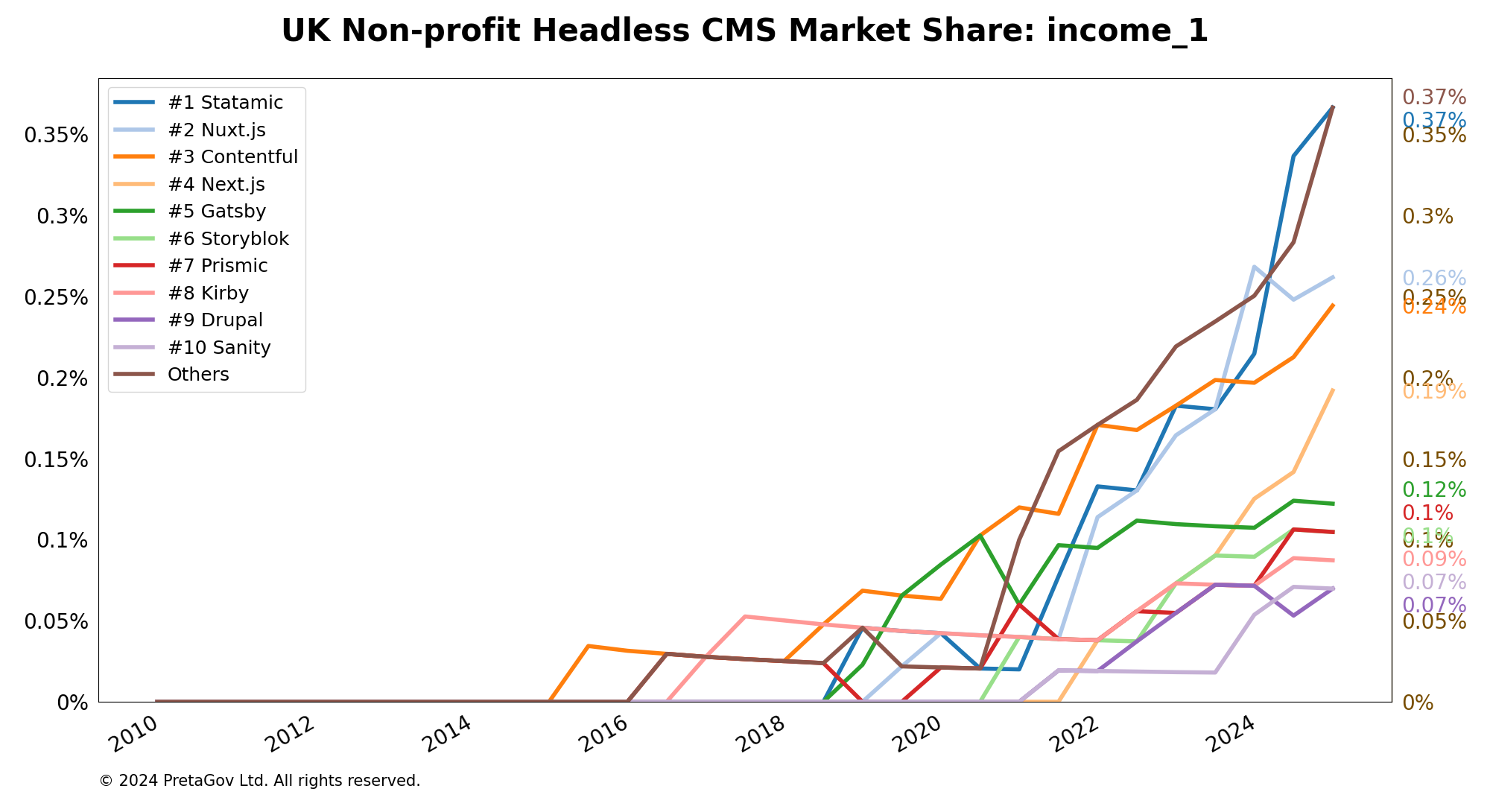
One thing about the Headless category is that it can be hard to detect the exact CMS used and in fact as a category it might slightly under-reported since some server-side rendered, or static site generated headless sites can be hard to detect that a headless CMS was used. This does mean the ranking of CMS vendor for this category is less useful.
Open source CMS trends 2024
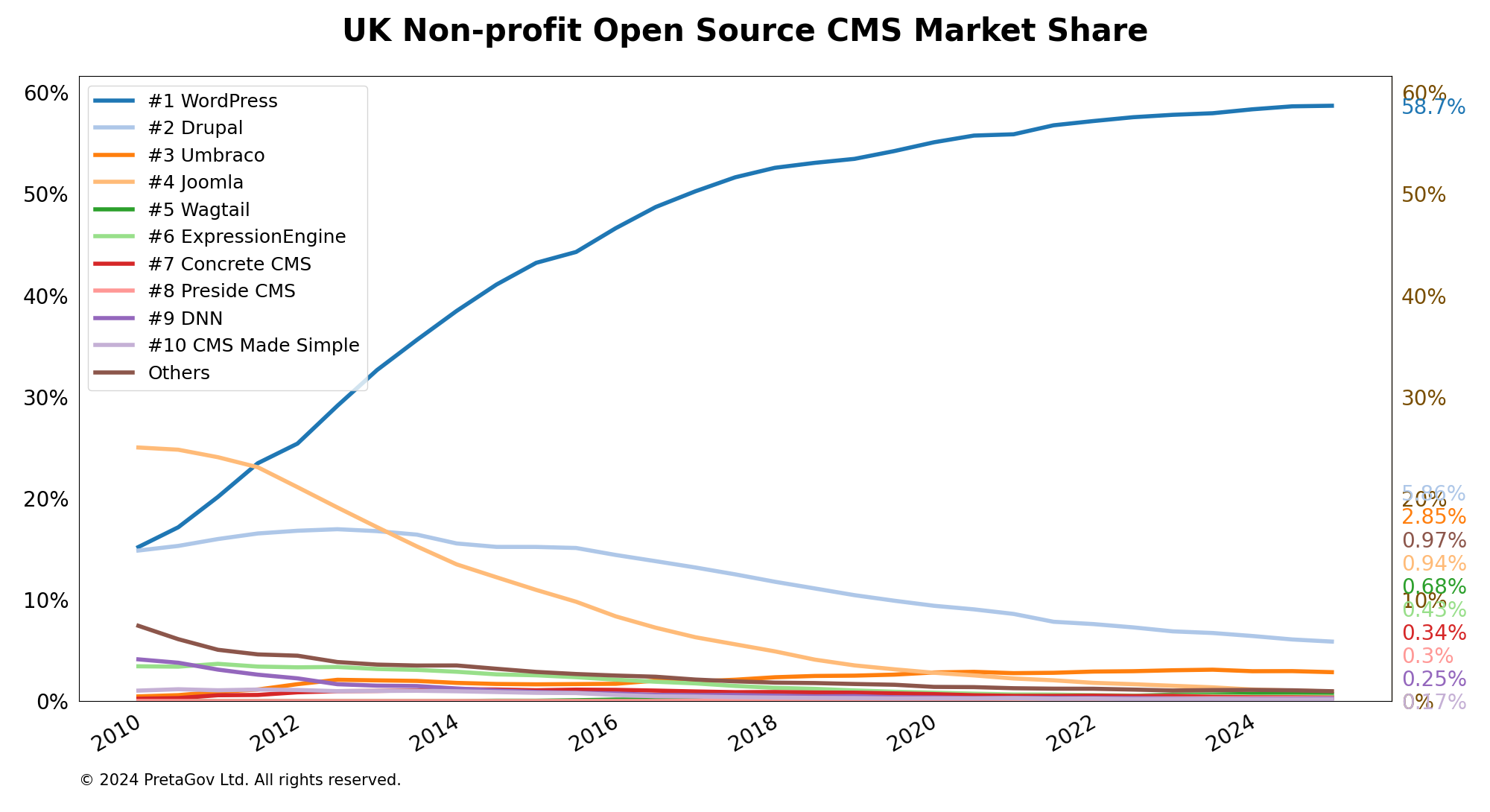
Almost all open source CMS is losing market share except WordPress. WordPress itself seems to be stagnating. Compared to other surveys of CMS marketshare such as builtwith
Licensed CMS trends 2024
Generally this category is declining with one notable exception. Craft CMS is growing.
SaaSification of CMS
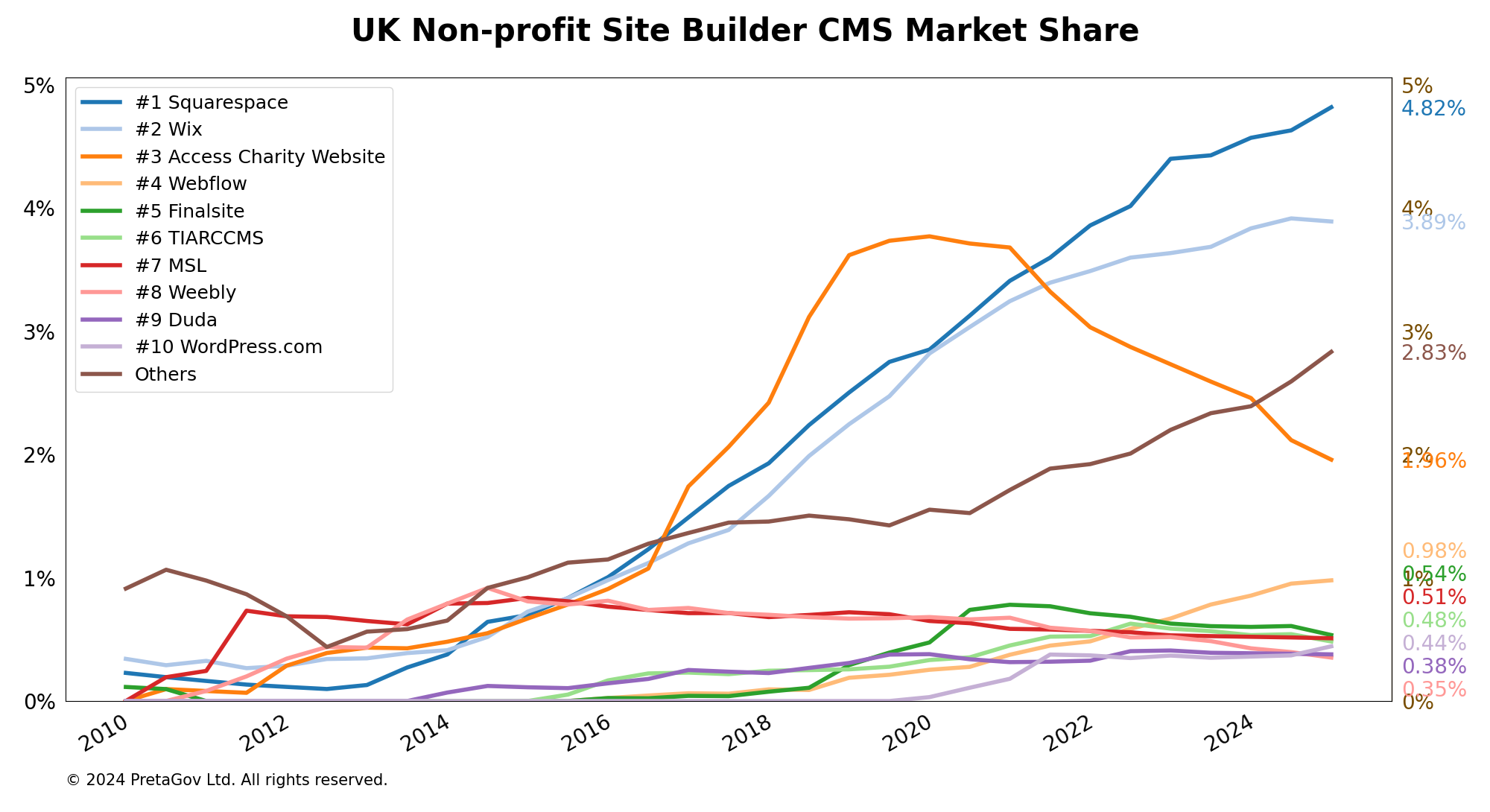
There was been much conjecture online about the stagnation of WordPress and why it's not growing anymore. One thing this data clearly shows is that there is a trend away from custom hosted solutions towards SaaS. WordPress is in fact a solution that comes is sold as both a site builder with prebuilt themes or site builder functionality that allows for customisation without code deployment. This data seperates wordpress.com site builder hosting into the Site builder grouping but for some other hosting providers like WPEngine it isn't currently possible to seperate those so the site builder category is an under estimate and the open source WordPress is an over estimate.
Why is there a trend toward SaaS?
- Site builders for verticals. This can be seen in the data where site builders with functionality targetting one vertical such as schools, churches, charities etc are reasonably popular. This could be because of marketing, price, functionality or ease of use.
- Lots of sites don't need to be so unique
- Maintainance burden. If you host yourself or outsource so a support company there is still a reasonably high cost to maintaining a site. Security patching, DDoS, upgrades that require redoing theming when the customisations are tightly integrated.
- Pricing
- Risk. A larger SaaS provider could be seen as a less risky option than a smaller agency or internal staff maintaining your site.
- Scaling.